
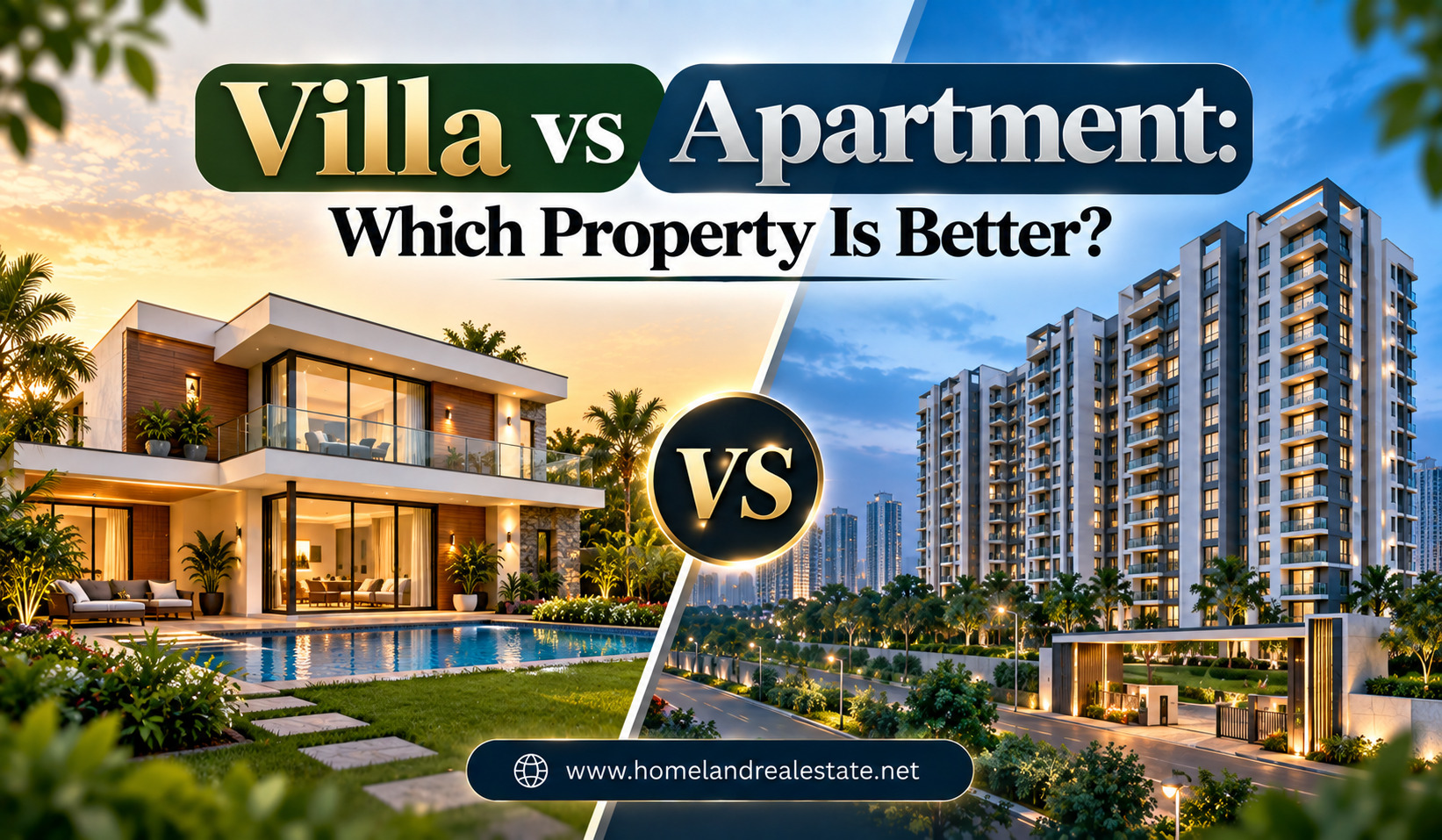
Buying a property is a major financial decision, and one of the biggest choices homebuyers face is whether to purchase a villa or an apartment. Both property types have their own advantages, and the better option depends on your budget, lifestyle, family size, location, maintenance preferences, and long-term plans.
Apartments are popular because they can offer better access to urban infrastructure, security, shared amenities, and comparatively affordable entry prices. Villas, on the other hand, offer greater privacy, more space, independent outdoor areas, and a stronger sense of ownership.
There is no universal answer to the question “villa vs apartment: which property is better?” The right choice depends on what you value most from your home.
What Is an Apartment?
An apartment is an individual residential unit within a larger building or residential complex. Owners typically share facilities such as lifts, parking areas, gardens, security systems, clubhouses, swimming pools, gyms, and other common spaces.
Apartments are particularly common in major Indian cities where land is expensive and housing demand is high. High-rise developments allow more families to live within a relatively small area.
Depending on the location and project, apartments can range from compact 1 BHK homes to large luxury 3 BHK, 4 BHK, and penthouse-style residences.
What Is a Villa?
A villa is generally an independent or semi-independent residential property with its own structure and private outdoor space. Villas can be located within gated communities or as standalone properties.
They usually offer more floor area and privacy than standard apartments. Depending on the design, a villa may include a private garden, terrace, balcony, driveway, parking area, or even a private swimming pool.
Villas are generally more expensive than apartments in the same locality because buyers are paying for additional land, construction area, privacy, and exclusive outdoor space.
Villa vs Apartment: Which Is More Affordable?
For most buyers, apartments are the more affordable option.
The total purchase price of an apartment is usually lower than that of a comparable villa in the same broad location. This makes apartments more accessible to first-time buyers, young professionals, and families working with a defined budget.
Villas require a larger upfront investment because they typically include more land and built-up space.
However, price comparisons should be made carefully. A premium apartment in a central location can cost more than a villa in a developing suburb.
Instead of comparing property types alone, compare the price per usable area, location, land component, amenities, and total ownership cost.
Space and Privacy
This is where villas generally have a significant advantage.
A villa can provide multiple floors, larger bedrooms, private terraces, gardens, and outdoor areas. Families can also enjoy greater separation between living and private spaces.
Apartments provide less private space because residents share walls, corridors, lifts, parking areas, and common facilities with other households.
For people who value privacy, enjoy outdoor space, or have larger families, a villa may therefore be more attractive.
However, modern luxury apartments can also offer large floor plans, private elevators, expansive balconies, and limited-density living, narrowing the difference in some premium developments.
Amenities and Lifestyle
Apartments, particularly those located in large gated communities, often have an advantage when it comes to shared amenities.
A residential project may include a clubhouse, swimming pool, gym, children’s play area, sports courts, walking tracks, gardens, community halls, and other facilities.
Maintaining these facilities independently in a villa can be expensive and time-consuming.
Some villa communities also offer extensive shared amenities, so the difference depends on the project.
If you enjoy having access to recreational facilities without personally maintaining them, an apartment in a well-managed community can be an attractive choice.
Maintenance Requirements
Apartments are generally easier to maintain.
The residential association or property management team usually handles common areas, security, lifts, landscaping, waste management, and other shared services.
Apartment owners still pay monthly maintenance charges, but many routine responsibilities are handled collectively.
Villas provide more independence but also greater responsibility. Owners may need to maintain their garden, exterior areas, private utilities, driveway, terrace, plumbing, and other components.
A villa with extensive outdoor space can therefore require more time and money to maintain.
Security
Security can be another important consideration.
Gated apartment communities generally provide controlled entry, security personnel, CCTV systems, visitor management, and other safety measures.
Villas within gated communities can also offer similar facilities. However, an independent villa may require the owner to arrange private security systems, cameras, alarms, and other protective measures.
For families who prioritise managed security, a well-run gated apartment or villa community can be more convenient than a standalone property.
Location and Connectivity
Apartments usually have an advantage in terms of location.
Because high-rise buildings use land efficiently, developers can construct apartment projects closer to established business districts, public transport, schools, hospitals, shopping areas, and other urban infrastructure.
Villas require considerably more land per household, so larger villa developments are often located farther from city centres.
This is not always the case, particularly in suburban and premium neighbourhoods, but buyers should carefully compare commuting times.
A spacious villa that requires a long daily commute may be less practical than a smaller apartment located close to work and essential services.
Villa vs Apartment for Families
Both can work well for families, but the ideal choice depends on family size and lifestyle.
A small family may find a 2 BHK or 3 BHK apartment perfectly comfortable, especially if the project offers parks and children’s facilities.
Larger families may prefer villas because of the additional bedrooms, multiple floors, private outdoor space, and greater flexibility.
Families who regularly host relatives or guests may also benefit from a villa’s extra space.
However, families with young children should consider safety carefully. Staircases, balconies, terraces, swimming pools, and private driveways may require additional precautions in villas.
Villa vs Apartment for Investment
From an investment perspective, both properties can work, but their performance depends heavily on location and demand.
Apartments generally have a broader buyer and tenant pool. They are often easier to rent in areas near IT parks, business districts, universities, hospitals, and public transportation.
Villas can attract affluent buyers and families seeking premium homes. In suitable locations, their land component can contribute significantly to long-term value.
However, villas usually have a higher purchase price, which can affect rental yield.
Investors should compare expected rent with the total purchase cost, maintenance expenses, taxes, vacancy risk, and potential resale demand.
Don’t assume that an expensive villa automatically provides better returns.
Capital Appreciation
Land availability is an important factor when considering long-term appreciation.
With apartments, buyers own a proportionate share of the underlying land along with their individual unit, but the value is also influenced by the building’s age and the supply of competing apartments.
Villas generally have a larger land component. In locations where land becomes scarce and demand increases, this can potentially support long-term appreciation.
However, location remains more important than property type. A well-connected apartment in a high-demand neighbourhood can outperform a poorly located villa.
Infrastructure, employment growth, population expansion, zoning regulations, and local development patterns can all affect future property values.
Resale Considerations
Apartments generally have a larger resale market because they appeal to a wider range of buyers.
This can make resale relatively straightforward in locations with strong demand and good connectivity.
Villas have a more limited buyer pool because of their higher prices and larger financial commitment. Finding the right buyer may take longer, particularly in peripheral locations.
On the other hand, unique villas in established premium neighbourhoods can be highly desirable because land availability is limited.
When evaluating resale potential, examine recent transactions in the locality rather than relying only on the developer’s projected appreciation.
Lifestyle and Independence
The lifestyle difference between villas and apartments can be substantial.
An apartment provides community living. You share facilities, follow society rules, and interact with a larger group of residents.
A villa provides greater independence. You generally have more control over your outdoor areas, renovations, interiors, and daily lifestyle.
If you enjoy privacy and personal space, a villa may feel more comfortable. If you enjoy community activities, shared amenities, and professional maintenance, an apartment may be more suitable.
Villa vs Apartment: Which Should You Choose?
Choose an apartment if:
- You want a lower entry price.
- You prefer living closer to major urban areas.
- You want access to shared amenities.
- You prefer professional maintenance of common facilities.
- You want strong rental demand in an employment hub.
- You prefer a community-oriented lifestyle.
- You want to reduce the amount of outdoor maintenance you handle yourself.
Choose a villa if:
- You want greater privacy.
- You need more space.
- You value a private garden or outdoor area.
- You have a larger family.
- You want greater control over your property.
- You are comfortable with higher maintenance responsibilities.
- You have a larger budget and a longer investment horizon.
Questions to Ask Before Buying
Before choosing between a villa and an apartment, evaluate your finances carefully.
Calculate not only the purchase price but also the down payment, home loan EMI, registration costs, taxes, maintenance charges, interiors, utilities, insurance, and potential repair expenses.
Also consider how long you expect to stay in the property. If you may relocate for work within a few years, an apartment in a high-demand location could be easier to rent or sell.
If you plan to live in the property for decades and value space and privacy, a villa may make more sense.
Always inspect the actual property and surrounding neighbourhood. Check road connectivity, water supply, drainage, electricity, parking, schools, hospitals, public transport, and nearby development.
For either property type, verify title documents, approvals, RERA registration where applicable, construction quality, and the developer’s or seller’s track record.
Final Thoughts
The villa vs apartment decision ultimately comes down to your priorities.
Apartments are generally better for buyers who want affordability, convenience, urban connectivity, shared amenities, and easier maintenance. Villas are more suitable for buyers who prioritise space, privacy, outdoor areas, independence, and long-term residential comfort.
Neither property type is automatically a better investment. The location, purchase price, construction quality, infrastructure, demand, and future development of the neighbourhood can have a much greater impact on returns.
For first-time buyers with a limited budget, a well-located apartment may provide a practical entry into homeownership. For larger families or buyers with higher budgets who want more privacy and space, a villa can provide a more expansive lifestyle.
Ultimately, the best property is the one that fits your financial capacity, lifestyle, family requirements, and long-term goals. Take time to compare both options, visit multiple properties, calculate the complete cost of ownership, and choose based on actual needs rather than simply choosing the property that looks more luxurious.