
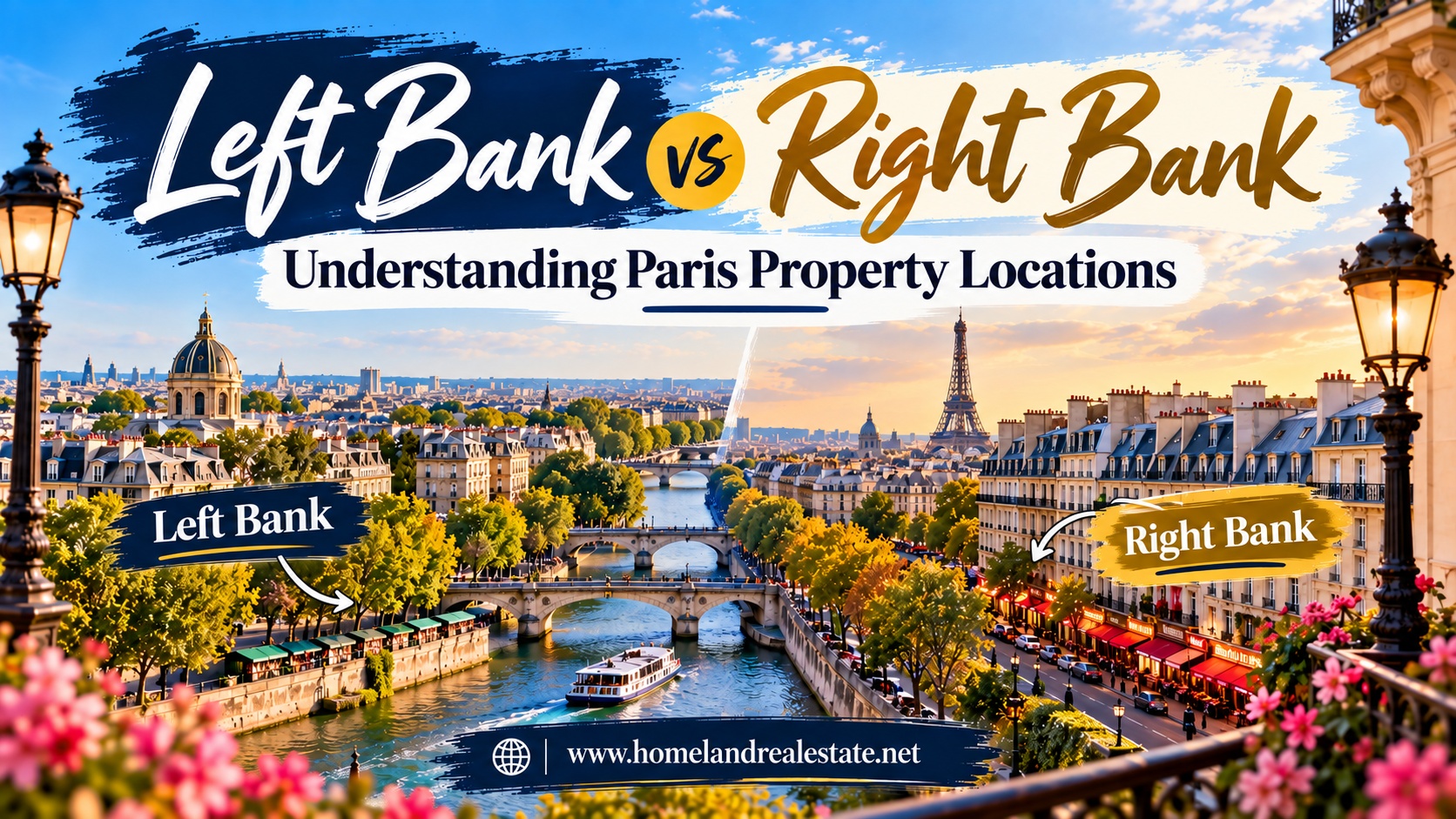
When you begin exploring property in Paris, one of the first location comparisons you may encounter is Left Bank vs Right Bank. The Seine divides the city geographically, but the differences between the two sides go beyond a river. Each has distinct neighbourhoods, architectural styles, lifestyle characteristics, commercial areas, and residential environments.
For homebuyers, understanding these differences can make property searches more focused. For investors, comparing the two sides can help when evaluating tenant preferences, transportation, property types, and long-term ownership considerations.
The choice is not simply about deciding which side is better. Both the Left Bank and Right Bank contain a wide range of neighbourhoods, and individual streets can differ significantly. The right choice depends on your lifestyle, property requirements, financial position, and investment objectives.
This Left Bank vs Right Bank guide explains the main differences and highlights what buyers should consider before purchasing property in Paris.
What Do Left Bank and Right Bank Mean?
The Seine runs through Paris and provides a simple geographic distinction between the two sides of the city.
The Left Bank refers broadly to areas south of the Seine, while the Right Bank refers to areas north of the river.
The distinction is useful, but it should not be treated as a complete description of Paris property. Each side includes numerous arrondissements and neighbourhoods with their own characteristics.
Left Bank Neighbourhoods
The Left Bank includes areas such as the 5th, 6th, 7th, 13th, 14th, and 15th arrondissements, among others.
These districts vary considerably. Some contain historic streets and prestigious residential properties, while others offer practical family housing, modern developments, and quieter residential environments.
Right Bank Neighbourhoods
The Right Bank includes areas such as the 1st, 2nd, 3rd, 4th, 8th, 9th, 10th, 11th, 16th, 17th, 18th, 19th, and 20th arrondissements, among others.
This side also offers considerable variety, from central historic neighbourhoods and major commercial districts to residential communities in northern and eastern Paris.
Left Bank vs Right Bank: How the Property Experience Differs
The biggest difference between the two sides is not one single property characteristic. Instead, the difference comes from the collection of neighbourhoods found on each side.
When comparing Left Bank vs Right Bank, buyers should think about location, architecture, transport, lifestyle, property size, and local amenities together.
The Left Bank is often associated with historic academic and cultural areas, while the Right Bank includes several major commercial, business, shopping, and entertainment districts.
However, these descriptions are broad. Individual neighbourhoods can challenge these generalisations.
Left Bank Property Characteristics
The Left Bank can appeal to buyers who appreciate historic architecture, cultural surroundings, established residential streets, and neighbourhoods with strong local identities.
5th and 6th Arrondissements
The 5th and 6th are among the best-known Left Bank areas.
The 5th includes the Latin Quarter and has a strong connection with education, history, culture, and traditional Parisian streets.
The 6th includes Saint-Germain-des-Prés and surrounding neighbourhoods. It combines residential buildings with cafés, shops, cultural venues, and established streets.
Buyers interested in apartments in these districts should carefully examine the age and condition of buildings. Historic charm can come with maintenance and renovation considerations.
7th Arrondissement
The 7th is known for elegant residential streets, major landmarks, and established apartment buildings.
It can appeal to buyers looking for a central location with a traditional Parisian atmosphere.
However, property within the same arrondissement can differ significantly depending on the exact street. Buyers should examine noise, natural light, floor level, transportation, and building condition.
13th, 14th, and 15th Arrondissements
Further south, the 13th, 14th, and 15th provide a broader range of residential environments.
These areas can be relevant to buyers seeking practical housing, local services, transportation access, and a more residential atmosphere.
The 13th also includes a mixture of older and modern buildings, while the 14th and 15th contain established residential communities.
For families, these districts may be worth considering when space and everyday convenience are more important than being surrounded by major tourist attractions.
Right Bank Property Characteristics
The Right Bank contains an especially broad range of property environments.
It includes central historic districts, major commercial areas, established residential neighbourhoods, and diverse communities farther east and north.
1st and 4th Arrondissements
The 1st and 4th are highly central and contain some of Paris’s most recognised historic areas.
Properties here can appeal to buyers who prioritise centrality and access to cultural and commercial destinations.
However, central locations can also mean higher levels of tourism, pedestrian activity, and traffic in some areas. The exact street and building therefore matter greatly.
8th and 9th Arrondissements
The 8th and 9th combine residential properties with business, retail, restaurants, entertainment, and cultural activity.
The 8th can appeal to buyers looking for prestigious central surroundings, while the 9th offers a mixture of residential streets and lively urban environments.
For homeowners, visiting a property at different times can help reveal whether the location provides the desired balance between convenience and quiet.
10th and 11th Arrondissements
The 10th and 11th are known for active urban neighbourhoods, restaurants, cafés, shops, transportation, and residential streets.
They can appeal to buyers who enjoy a more dynamic city environment.
Investors may also consider these districts when researching apartments for tenants who value access to employment, transportation, and local amenities.
16th and 17th Arrondissements
The 16th and 17th offer established residential environments and a variety of apartment types.
The 16th is associated with spacious residential properties and green spaces in several areas, while the 17th combines traditional neighbourhoods with newer development.
These districts can be relevant to families and long-term homeowners who want residential comfort without leaving Paris.
Comparing the Left Bank and Right Bank
The following table provides a broad starting point for property research:
| Factor | Left Bank | Right Bank |
| General character | Historic, cultural, academic, residential | Commercial, historic, residential, diverse |
| Well-known areas | 5th, 6th, 7th | 1st, 4th, 8th, 9th, 16th |
| Family-oriented options | 13th, 14th, 15th | 12th, 16th, 17th, 19th, 20th |
| Property variety | Historic apartments and modern residential areas | Very broad mix of historic and modern housing |
| Lifestyle | Cultural and established residential environments | Wide range from business districts to lively residential areas |
| Main consideration | Exact neighbourhood and building condition | Exact neighbourhood, transport, and surrounding activity |
These are broad descriptions rather than rules. A buyer should always investigate the specific property and micro-location.
Architecture and Building Character
Architecture can be an important factor in the Left Bank vs Right Bank comparison.
Both sides contain historic Parisian buildings, including properties associated with traditional stone façades, balconies, tall windows, decorative details, and classic apartment layouts.
Historic Apartments
Historic apartments can offer distinctive character but may require greater attention to maintenance and renovation.
Buyers should inspect flooring, windows, ceilings, plumbing, electrical systems, heating, ventilation, and signs of moisture.
Building-level maintenance is equally important.
Modern Apartments
Modern developments may offer different layouts, newer systems, contemporary facilities, and potentially more practical configurations for today’s households.
However, newer construction does not automatically make a property better. Buyers should compare location, space, quality, maintenance arrangements, and overall affordability.
Transportation and Daily Convenience
Transportation is another important part of the Left Bank vs Right Bank decision.
Paris has an extensive public transportation network, but accessibility varies by exact location.
When comparing properties, look at the nearest metro stations, bus services, walking routes, and connections to destinations that matter to you.
Think About Your Actual Routine
A property that appears centrally located may still be inconvenient if your regular destinations require multiple transfers.
Homebuyers should consider their workplace, schools, family commitments, shopping needs, and leisure activities.
Investors should think about the transportation requirements of likely tenants.
Property Size and Lifestyle
Lifestyle can influence the type of property that makes sense.
Someone seeking a compact apartment for an urban lifestyle may have different priorities from a family looking for several bedrooms and storage.
In the Left Bank vs Right Bank comparison, buyers should therefore avoid focusing only on the reputation of a district.
Families
Families may prioritise schools, parks, supermarkets, healthcare, quiet streets, storage, apartment size, and transportation.
A less tourist-focused neighbourhood may sometimes offer a more practical daily environment.
Professionals
Professionals may place greater emphasis on commuting, restaurants, public transportation, and proximity to business districts.
Both sides of the Seine offer neighbourhoods that can suit this lifestyle.
Long-Term Homeowners
Long-term buyers should consider whether they can see themselves living comfortably in the area for many years.
The quality of the building, apartment layout, neighbourhood services, and local atmosphere may matter more than short-term trends.
Investment Considerations
Investors comparing Left Bank vs Right Bank should approach the decision analytically.
A prestigious location may attract attention, but investment performance depends on many factors.
Consider tenant demand, comparable properties, rental competition, apartment size, condition, transportation, operating costs, financing, and potential vacancy.
Do Not Assume Location Guarantees Returns
Neither the Left Bank nor Right Bank automatically guarantees rental income or property appreciation.
An apartment with poor natural light, significant maintenance requirements, an awkward layout, or high ownership costs may be less attractive despite being in a well-known district.
The property itself must be analysed alongside the location.
Financing Your Paris Property Purchase
Whether you choose the Left Bank or Right Bank, financing should be evaluated carefully.
If you are using a home loan or mortgage, consider the complete cost of ownership rather than only the monthly repayment.
Purchase-related expenses, applicable taxes and charges, building expenses, maintenance, renovation, insurance where applicable, and financing costs can all affect affordability.
International buyers should obtain appropriate professional advice for their circumstances before committing to a purchase.
What to Inspect Before Buying
A property viewing should go beyond appearance.
Examine the Apartment
Check:
- Natural light
- Noise
- Windows
- Floor condition
- Ceiling and walls
- Plumbing
- Electrical systems
- Heating and ventilation
- Storage
- Room layout
- Signs of moisture
Examine the Building
Also investigate:
- Common areas
- Entrance and security
- Lift condition
- Building maintenance
- Planned work
- Management arrangements
- Shared expenses
- General condition
These details can significantly affect the practical and financial experience of owning an apartment.
How to Choose Between the Left Bank and Right Bank
The decision should start with your priorities.
If you value historic academic and cultural surroundings, some Left Bank neighbourhoods may fit your lifestyle. If you want access to major commercial districts, varied urban environments, or particular transport connections, certain Right Bank areas may be more suitable.
But these are only starting points.
The best approach is to shortlist individual neighbourhoods and then compare specific properties.
Create a Property Checklist
Before viewing homes, establish your priorities for:
- Budget
- Apartment size
- Number of bedrooms
- Transportation
- Schools and amenities
- Building age
- Renovation requirements
- Natural light
- Noise
- Long-term affordability
- Investment objectives
A clear checklist can prevent an attractive location from distracting you from important practical considerations.
Frequently Asked Questions
1. What is the main difference between the Left Bank and Right Bank in Paris?
The Seine separates the two sides, but their property environments vary widely, with the Left Bank containing many historic and cultural areas and the Right Bank offering a broad mixture of commercial, residential, historic, and modern neighbourhoods.
2. Is the Left Bank better for families?
Some Left Bank neighbourhoods can suit families because of their residential streets, amenities, schools, parks, and transportation, but the suitability of a property depends on its exact location and the family’s requirements.
3. Is the Right Bank suitable for property investment?
The Right Bank contains many different residential environments that may suit investors, but investment potential should be assessed through tenant demand, competing properties, property condition, financing, operating costs, and vacancy considerations.
4. Are apartments on both sides of the Seine similar?
No, both sides contain a wide range of apartment types, including historic properties, renovated flats, newer developments, compact apartments, and larger family homes.
5. What should I consider when choosing between the Left Bank and Right Bank?
Consider your budget, preferred neighbourhood atmosphere, transportation, property size, building condition, amenities, renovation requirements, financing, long-term lifestyle, and investment objectives before choosing a location.