
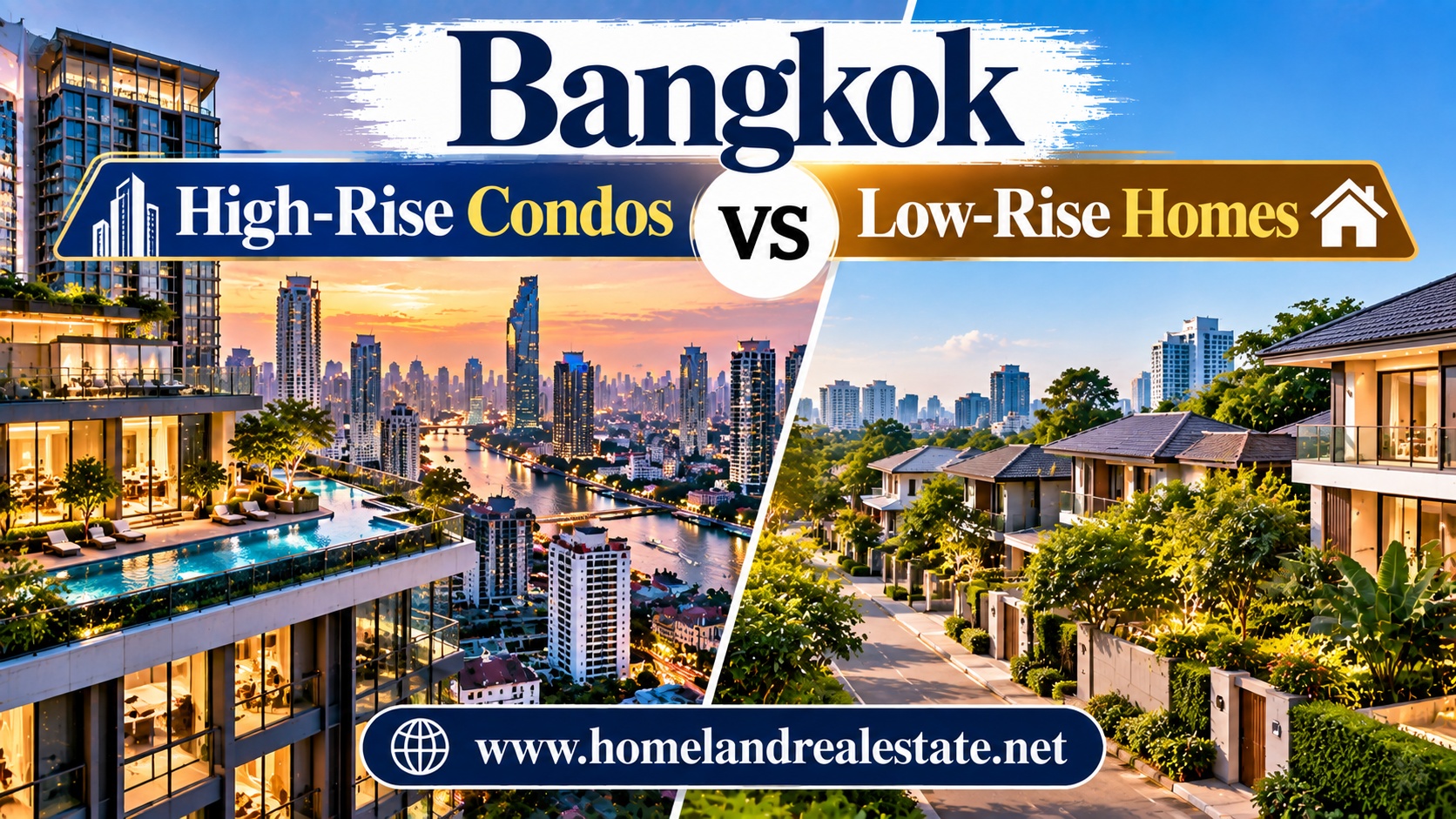
Choosing between a high-rise condominium and a low-rise home is an important decision when buying property in Bangkok. Both options can provide comfortable living, but they offer very different experiences in terms of space, privacy, facilities, maintenance, transportation, and everyday convenience.
Bangkok High-Rise Condos vs Low-Rise Homes is not simply a comparison between tall buildings and smaller properties. It is a decision about the lifestyle you want, the location you prefer, your available budget, and how much responsibility you want to take on as a homeowner.
High-rise condos can appeal to buyers who value urban convenience, views, shared facilities, and access to transportation. Low-rise homes may be more suitable for buyers who want additional privacy, outdoor space, and greater control over their living environment.
This guide explains the key differences between Bangkok high-rise condos and low-rise homes and highlights the factors you should consider before making a property purchase.
Understanding Bangkok High-Rise Condos vs Low-Rise Homes
The first step is understanding how these property types differ.
A high-rise condo is typically located within a multi-storey residential building containing multiple individual units and shared facilities. Residents may have access to features such as lifts, security systems, fitness areas, swimming pools, common lounges, parking, or other shared spaces, depending on the development.
A low-rise home provides a different experience. It may be a townhouse, detached house, or low-rise residential property with fewer floors and potentially more direct control over the living space.
When comparing Bangkok High-Rise Condos vs Low-Rise Homes, you should therefore consider the entire property environment rather than just the size of the unit.
Location and Urban Convenience
Location is one of the strongest factors in the comparison.
High-rise developments are often attractive to buyers who want to live in active urban areas. A well-positioned condo can provide convenient access to public transportation, offices, shopping, restaurants, entertainment, and other services.
Low-rise homes can also be located in well-connected neighbourhoods. However, the surrounding environment may be more residential and less concentrated with commercial activity.
Think About Your Daily Routine
Before buying, consider where you travel most often.
If you commute frequently, access to public transportation may be especially important. If you work from home or spend most of your time within your neighbourhood, you may place greater value on space, privacy, and a quieter environment.
The best property is the one that works with your daily routine.
Living Space and Floor Plans
Space is another major difference when considering Bangkok High-Rise Condos vs Low-Rise Homes.
High-rise condos often use carefully planned floor areas. A well-designed apartment can provide bedrooms, living areas, kitchens, bathrooms, and storage within a relatively compact footprint.
However, buyers who need several bedrooms, large storage areas, separate workspaces, or private outdoor areas may find low-rise homes more flexible.
Consider Future Space Requirements
Your current needs should not be the only consideration.
Think about whether your household may grow, whether you will need a home office, whether you expect relatives to stay with you, or whether you have hobbies that require additional space.
Buying a property that is too small can create problems later. At the same time, purchasing significantly more space than you need can increase your maintenance and financial responsibilities.
Privacy and Noise
Privacy can be an important advantage of low-rise living.
A house may provide greater separation from neighbours, particularly when it has private outdoor space. However, privacy varies considerably between different low-rise developments.
High-rise condos involve shared walls, corridors, lifts, and common areas. The level of privacy can depend on the building design, unit location, number of neighbouring units, and overall management.
Inspect Noise During Your Visit
Do not judge noise based only on a short daytime viewing.
Listen for traffic, nearby construction, lifts, corridors, neighbouring units, commercial activity, and other sources of noise.
If possible, visit at different times of day to understand the property’s environment more realistically.
Views and Natural Light
High-rise living can provide one feature that low-rise properties cannot always match: elevated views.
Higher-floor condos may offer broader views across the surrounding city. Natural light can also be an attractive feature depending on the unit’s orientation and surrounding buildings.
However, buyers should not assume that every high-rise apartment will have a great view.
Inspect the Unit Orientation
When viewing a condo, examine the direction of the main windows and balcony.
Look at nearby buildings and consider whether the current outlook could change because of future development.
For low-rise homes, natural light can depend on plot orientation, neighbouring structures, gardens, walls, and the home’s design.
Facilities and Shared Amenities
One advantage often associated with high-rise condos is access to shared facilities.
Depending on the development, residents may have access to swimming pools, gyms, gardens, lounges, security systems, parking, or other communal areas.
These facilities can provide convenience without requiring the homeowner to maintain them individually.
Low-rise homes may not offer the same range of shared facilities, but they can provide more private space.
Decide Which Facilities You Will Actually Use
Do not choose a property simply because the building has an impressive list of amenities.
Think about your actual lifestyle.
If you regularly use a gym or swimming pool, shared facilities may add genuine value. If you rarely use them, they should have less influence on your decision.
Maintenance Responsibilities
Maintenance is another important factor.
In a high-rise condo, many common building areas are maintained collectively through the building’s management arrangements. Individual owners are still responsible for their units and associated ownership costs.
With a low-rise home, the owner may have greater responsibility for the property itself and, depending on the type of home, outdoor areas.
Think About Your Time
A house can provide more control, but greater control often means more work.
Gardens, exterior surfaces, drainage, roofing, plumbing, electrical systems, and other components may require attention.
Apartment living can simplify some aspects of maintenance, but buyers should still carefully review building management and common-area maintenance.
High-Rise Condos vs Low-Rise Homes: Key Differences
| Factor | High-Rise Condos | Low-Rise Homes |
| Living environment | Vertical, shared residential building | Lower-density residential setting |
| Privacy | Depends on building and unit | Often greater potential for privacy |
| Outdoor space | Balcony or shared areas may be available | Private outdoor space may be available |
| Views | Higher floors may provide wider views | Views depend on surrounding homes and location |
| Facilities | Shared amenities may be available | Usually more private living space |
| Maintenance | Shared building maintenance arrangements | More direct property responsibility |
| Transportation | Often attractive in connected urban areas | Depends heavily on neighbourhood |
| Space | Usually more compact | Potentially more flexible |
| Lifestyle | Urban and amenity-focused | Residential and space-focused |
This comparison is a starting point. Individual properties can differ significantly.
Transportation and Commuting
For many Bangkok buyers, transportation is a major consideration.
A high-rise condo near a BTS or MRT station can be convenient for residents who rely on public transportation.
However, proximity to a station should not automatically make a condo the better purchase.
Low-rise homes can also be practical when they are near suitable transport connections, major roads, schools, workplaces, or other important destinations.
Test the Commute
Before buying, consider how long your regular journeys actually take.
If possible, travel the route during your normal commuting period.
A property that looks convenient on a map may feel very different when you experience the route during busy hours.
Family-Friendly Considerations
Families should consider how the property will function as household needs change.
High-rise condos can provide security, shared facilities, convenient locations, and access to nearby services. However, families may eventually need more bedrooms, storage, study areas, or private outdoor space.
Low-rise homes can provide greater flexibility for these needs.
Think Beyond Bedrooms
A family home should also be evaluated based on schools, healthcare, shopping, recreation, transport, noise, safety considerations, and the general character of the neighbourhood.
The best property is not necessarily the one with the largest floor area. It is the one that supports the family’s complete routine.
Home Loans and Budget Planning
Your financing position should be established before selecting between a condo and a house.
Do not focus only on the purchase price.
Consider the complete ownership budget, including financing costs, maintenance, insurance where applicable, utilities, renovation expenses, property-related charges, and other costs relevant to your circumstances.
Leave Room for Unexpected Expenses
A realistic property budget should allow some flexibility.
High-rise condos may involve shared building expenses, while low-rise homes can require direct spending on repairs and outdoor maintenance.
Understanding these differences can help you avoid choosing a property that becomes financially uncomfortable after purchase.
Investment Considerations
Both high-rise condos and low-rise homes can be considered by property investors, but their potential tenant markets can differ.
High-rise condos may appeal to tenants who prioritise transportation, urban amenities, security, facilities, and convenient locations.
Low-rise homes may appeal to households looking for additional space, privacy, and a more residential environment.
Match the Property to the Tenant
Investors should identify their target tenant before purchasing.
Consider the likely demand for the property’s size, location, layout, facilities, and overall cost.
Do not assume that a high-rise condo will automatically provide better rental performance than a low-rise home.
Potential vacancy, maintenance, financing costs, competition, tenant preferences, and changing market conditions all need to be considered.
Resale and Long-Term Flexibility
Your future plans should also influence your decision.
If you may sell the property later, consider how broadly appealing it could be to future buyers.
A well-maintained condo in a convenient location may attract buyers who value urban living. A low-rise home with practical space may appeal to families or buyers who prioritise privacy.
Buy With Your Future in Mind
Try to avoid purchasing solely because a property is attractive today.
Consider how your employment, household size, lifestyle, and financial circumstances could change.
A property that provides some flexibility may be easier to live with over a longer ownership period.
Construction and Property Condition
Regardless of property type, construction quality should be carefully evaluated.
For high-rise condos, inspect common areas, lifts, entrances, corridors, parking, facilities, and the general condition of the building.
For low-rise homes, pay attention to the roof, exterior walls, drainage, plumbing, electrical systems, windows, foundations where accessible, and outdoor areas.
Consider a Professional Inspection
A property can look excellent during a viewing while still requiring future repairs.
Where appropriate, professional inspection or technical advice can help identify issues that are difficult for an ordinary buyer to detect.
This is especially useful when considering an older property or a home that requires significant renovation.
Which Property Type Is Right for You?
The choice between Bangkok High-Rise Condos vs Low-Rise Homes ultimately depends on your priorities.
A high-rise condo may suit you if you value convenient transportation, shared facilities, city views, and a more compact lifestyle.
A low-rise home may be better suited to you if you want privacy, additional space, outdoor areas, and greater control over the property.
Neither option is universally superior.
Your budget, household requirements, daily commute, maintenance preferences, investment strategy, and long-term plans should guide the final decision.
FAQs About Bangkok High-Rise Condos vs Low-Rise Homes
1. What is the main difference between a high-rise condo and a low-rise home?
A high-rise condo generally offers vertical apartment living with shared facilities, while a low-rise home usually provides more direct access to private living space and potentially greater privacy.
2. Are high-rise condos suitable for families in Bangkok?
Yes, high-rise condos can suit families when the unit provides enough bedrooms, storage, living space, suitable facilities, and convenient access to schools and everyday services.
3. Do low-rise homes require more maintenance than condos?
They can require more direct maintenance because homeowners may be responsible for areas such as exterior surfaces, gardens, drainage, and other parts of the property.
4. Which is better for a Bangkok property investor, a condo or a low-rise home?
Neither is automatically better because investors should compare location, target tenants, property condition, ownership costs, financing, competition, and investment risks.
5. What should buyers check before choosing between these property types?
Buyers should compare location, transportation, floor plan, privacy, maintenance responsibilities, construction quality, financing requirements, outdoor space, amenities, and long-term suitability.