
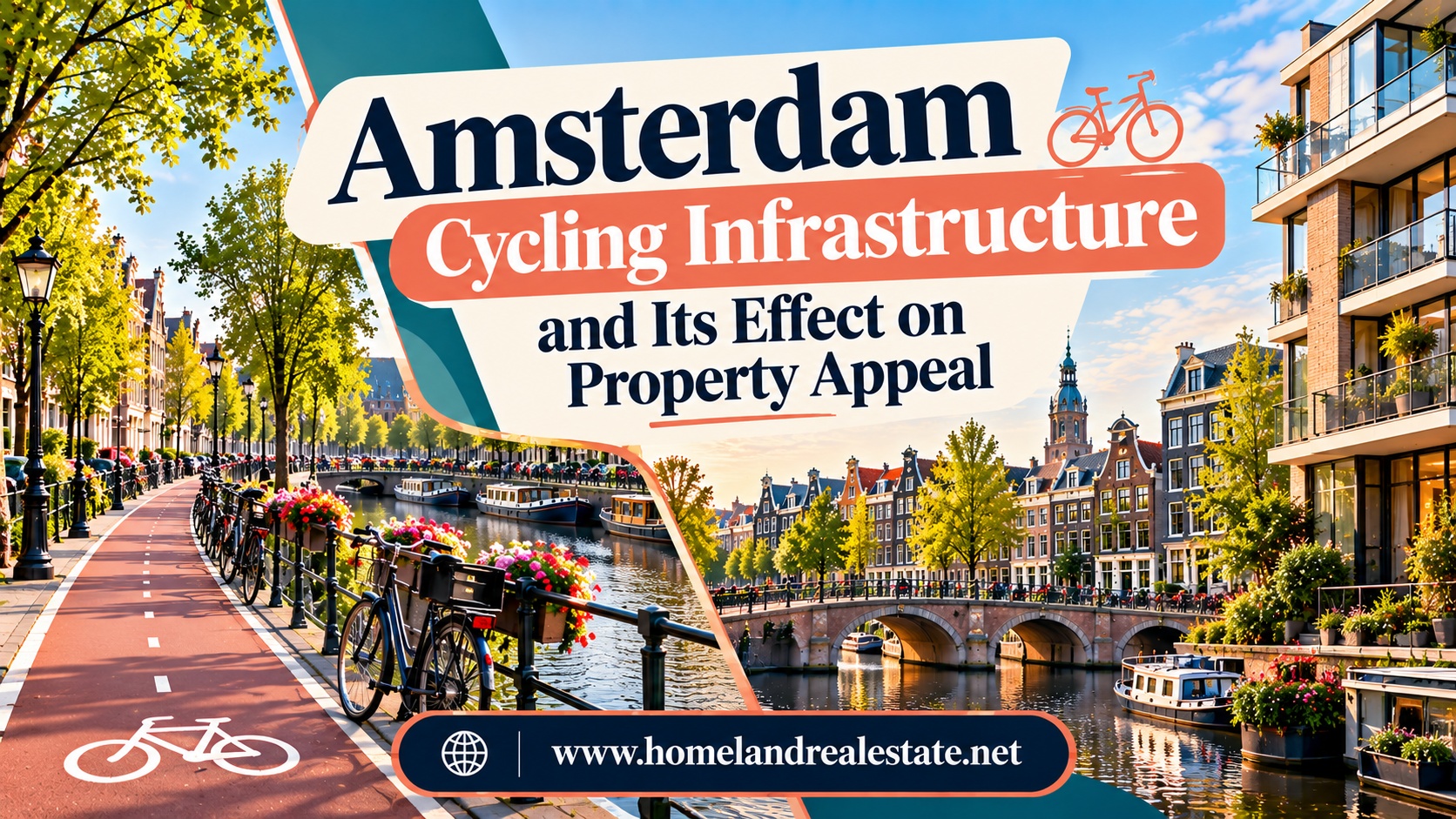
Amsterdam is widely associated with cycling, and bicycles are an important part of everyday movement across the city. Dedicated cycling routes, bike-friendly streets, bicycle parking, and connections between residential areas and important destinations can influence how people experience different neighbourhoods.
For property buyers, this makes Amsterdam cycling infrastructure more than a transport consideration. It can also form part of the broader lifestyle appeal of a residential location. A home that allows residents to reach work, shops, schools, parks, or public transport conveniently by bicycle may feel more practical for everyday living.
However, cycling access should not be treated as a guarantee of higher property values or investment returns. Property appeal depends on many factors, including location, housing quality, neighbourhood services, public transport, building condition, and buyer demand.
Understanding the relationship between Amsterdam cycling infrastructure and property appeal can help homebuyers and investors evaluate locations more carefully.
Why Cycling Infrastructure Matters to Residential Buyers
Transport convenience is one of the factors people consider when choosing where to live. In a city where cycling is an established part of daily life, the quality and connectivity of cycling routes can affect how easily residents move around their neighbourhood.
A well-connected cycling environment can make short journeys feel more manageable. Instead of depending on a car for every trip, residents may have another practical option for commuting, shopping, visiting local services, or reaching public transport.
For buyers, this can add to the overall usability of a location.
Cycling and Everyday Convenience
A property’s appeal is often shaped by what residents can conveniently access from the front door.
When cycling routes connect residential streets with workplaces, commercial areas, schools, parks, and transport hubs, the surrounding neighbourhood may offer a stronger sense of everyday connectivity.
This does not mean every home near a cycling route is automatically more desirable. Buyers should consider the quality, safety, directness, and practicality of the actual routes rather than simply measuring distance.
Amsterdam Cycling Infrastructure and Property Appeal
The relationship between Amsterdam cycling infrastructure and property appeal can be understood through several connected factors.
| Cycling-related factor | Potential effect on property appeal |
| Connected cycling routes | Can improve everyday mobility |
| Secure bicycle storage | Adds practical value for residents |
| Access to local services | Can make neighbourhood living more convenient |
| Links to public transport | Supports combined cycling and transit journeys |
| Bike-friendly streets | May contribute to a more accessible local environment |
| Poor route connectivity | Can reduce the practical benefit of cycling access |
These factors should be assessed alongside conventional property considerations rather than used in isolation.
Location and Cycling Accessibility
Location remains one of the most important considerations when buying residential property.
Two apartments with similar layouts and finishes can feel very different if one provides easier access to important destinations.
When viewing a property, consider the cycling journey rather than simply looking at a map. A short distance does not always mean a convenient route.
Test the Route Yourself
If possible, cycle from the property to places that matter to you.
Try routes to the workplace, nearest supermarket, school, train station, park, or other frequently visited destinations.
This can reveal practical details that are difficult to understand from a property listing.
You may discover that one neighbourhood provides a direct route while another requires more complicated connections.
Cycling Infrastructure and Public Transport
Cycling and public transport can complement each other.
A resident may cycle to a station and continue the journey by train or another form of public transportation. This can expand the practical area that residents can reach without relying entirely on private vehicles.
For property buyers, proximity to both cycling routes and public transport can therefore be an important combination.
Why the Combination Matters
A home does not necessarily need to be directly beside a major transport hub to be convenient.
A well-connected cycling route can extend the practical reach of nearby public transport. This may make certain residential areas more attractive to people who want flexible commuting options.
Buyers should consider the complete journey rather than evaluating cycling and public transport separately.
Bicycle Storage Can Affect Property Appeal
For residents who cycle frequently, storage is not a minor detail.
A property may have excellent cycling access, but the experience can become less convenient if residents have nowhere practical and secure to store their bicycles.
When viewing apartments, examine available bicycle storage carefully.
Ask whether storage is private or shared, where it is located, how easy it is to access, and whether the arrangement works for the number and type of bicycles you expect to own.
Consider Everyday Accessibility
Carrying a bicycle through narrow staircases or storing it inside a small apartment can quickly become inconvenient.
A dedicated bicycle room or accessible storage area may therefore add practical appeal to a property, particularly for households where cycling is part of daily life.
Cycling and Neighbourhood Lifestyle
Transport infrastructure can influence more than commuting.
Cycling can make it easier for residents to explore local cafés, shops, markets, parks, cultural venues, and community spaces.
This can contribute to a neighbourhood’s lifestyle appeal.
For homebuyers, the question is not simply whether cycling infrastructure exists. It is whether it supports the kind of daily life they want to have.
Impact on Different Types of Buyers
Not every buyer gives cycling the same importance.
First-Time Buyers
First-time buyers often need to balance purchase affordability with location and everyday convenience.
A neighbourhood with practical cycling connections may allow buyers to consider areas beyond the immediate surroundings of their workplace or transport station.
This can broaden the range of properties they evaluate.
Families
Families may consider cycling infrastructure alongside schools, parks, healthcare services, shopping, and public transport.
Safe and convenient routes can be particularly relevant when different household members need to reach multiple destinations.
Parents should still evaluate individual streets and routes rather than assuming that a citywide cycling network makes every route equally suitable.
Property Investors
For investors, cycling infrastructure can be one part of a broader location assessment.
A neighbourhood that offers strong mobility options may appeal to certain tenant groups, particularly people who value convenient urban transportation.
However, investors should avoid treating cycling access as a standalone investment thesis. Rental demand, property condition, acquisition costs, financing, ongoing expenses, and local housing characteristics remain important.
Does Cycling Infrastructure Increase Property Values?
This question requires a careful answer.
Good transport connections can contribute to the appeal of a residential location, but it is difficult to attribute a property’s value to cycling infrastructure alone.
Property prices and demand can be influenced by many factors at the same time.
These may include neighbourhood reputation, public transport, employment access, housing supply, building quality, amenities, environmental conditions, and broader market conditions.
Therefore, buyers should view Amsterdam cycling infrastructure as one component of a location’s overall appeal rather than assuming it guarantees price appreciation.
How Investors Can Evaluate Cycling Access
Investors can incorporate cycling considerations into their wider property analysis.
Start by identifying the likely tenant profile. Consider whether those tenants are likely to value cycling access and how the property’s location supports their daily routines.
Then examine the actual cycling connections to important destinations.
Consider the Whole Neighbourhood
A single cycle lane is less meaningful if it does not connect effectively to the rest of the network.
Look at the routes surrounding the property and determine whether they provide practical access to transport, employment areas, commercial districts, education, parks, and other destinations.
This broader perspective is more useful than simply noting that a cycling route exists nearby.
Cycling Infrastructure and Property Search Strategy
Homebuyers can make cycling infrastructure part of their initial property search.
When comparing neighbourhoods, create a checklist that includes:
- Cycling access
- Public transport
- Shops and essential services
- Schools and childcare where relevant
- Parks and green spaces
- Walking conditions
- Noise and traffic
- Bicycle storage
- Building condition
- Future lifestyle requirements
This approach prevents one attractive feature from dominating the entire property decision.
New Builds and Cycling Facilities
Modern residential developments may provide dedicated bicycle storage or other cycling-related facilities as part of their design.
Buyers should examine these facilities just as carefully as kitchens, bathrooms, storage, and parking.
Do not assume that a new development automatically provides the ideal cycling setup. Check accessibility, security, capacity, and convenience.
For buyers considering new build apartments in Amsterdam, bicycle facilities can be an important practical part of the overall residential package.
Older Homes and Cycling Considerations
Older Amsterdam properties can offer excellent access to established cycling routes, particularly in central and mature neighbourhoods.
However, the building itself may have limited bicycle storage or difficult access.
This creates an important distinction between neighbourhood cycling infrastructure and property-level cycling facilities.
A home can have excellent connectivity while still presenting practical storage challenges.
How Cycling Can Influence Home Improvements
For homeowners, cycling habits can also influence renovation decisions.
If bicycle storage is limited, owners may consider ways to improve the organisation of available space.
Storage solutions should be planned carefully so that they do not create access problems or compromise living areas.
For apartment owners, changes affecting shared spaces should be considered within the applicable building and ownership arrangements.
What Buyers Should Ask During a Property Viewing
When cycling is important to your lifestyle, add specific questions to your property viewing checklist.
Ask where bicycles can be stored, whether storage is secure, and how easily residents can access it.
Then examine the route outside the property.
Consider the street environment, nearby cycling connections, traffic conditions, intersections, and the ease of reaching your most important destinations.
A few minutes of practical observation can provide more useful information than a simple distance measurement.
Common Mistakes to Avoid
One mistake is assuming that being close to a cycling route automatically means the property has excellent cycling access.
Another is ignoring bicycle storage.
Buyers can also overlook the relationship between cycling and public transport. A property may become considerably more convenient when both options work together.
Finally, do not allow cycling infrastructure to overshadow fundamental property considerations such as building condition, financing, location, layout, and long-term suitability.
A Balanced Approach to Property Appeal
The strongest property decisions usually come from considering several factors together.
Amsterdam cycling infrastructure can support residential convenience, but it works best as part of a larger network of amenities and transportation options.
For homeowners, the main question is whether cycling improves daily life.
For investors, the question is whether the location’s overall accessibility supports the type of tenant demand being targeted.
Neither perspective should rely on assumptions about guaranteed price growth.
FAQs
1. How does Amsterdam cycling infrastructure affect property appeal?
It can improve everyday mobility and make some residential locations more convenient, although property appeal also depends on factors such as public transport, amenities, building quality, and neighbourhood characteristics.
2. Should buyers prioritise cycling access when choosing an Amsterdam home?
Cycling access can be an important priority for buyers who cycle regularly, but it should be evaluated alongside location, property condition, financing, layout, and other lifestyle requirements.
3. Does a property need to be directly beside a cycling route?
No, because a home’s overall cycling convenience depends on how effectively nearby routes connect with important destinations rather than simply its distance from one route.
4. Why is bicycle storage important when buying an Amsterdam apartment?
Convenient and secure bicycle storage can make daily cycling considerably easier and can be an important practical feature for households that rely on bicycles.
5. Can cycling infrastructure guarantee higher property returns?
No, cycling infrastructure may contribute to location appeal, but investment performance depends on multiple factors and should not be based on cycling access alone.