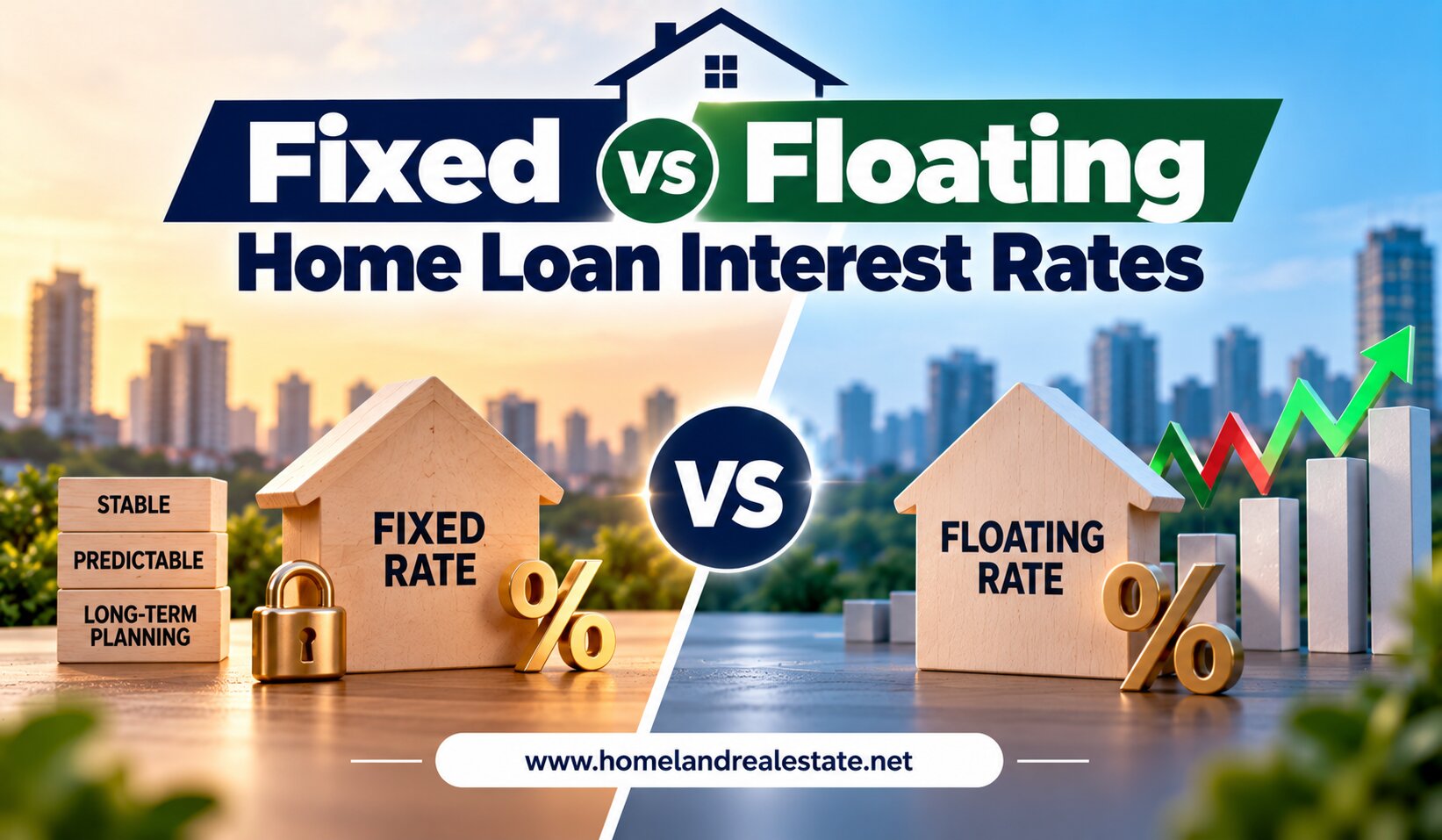
Choosing the right home loan is an important part of buying a property. While borrowers often compare loan amounts and eligibility, the interest rate structure can have an equally significant impact on the total cost of borrowing.
Home loans are commonly offered with fixed or floating interest rates, although the exact products and terms vary between lenders. A fixed rate generally provides greater certainty, while a floating rate can move up or down based on the applicable benchmark and lender’s spread.
For buyers in India, understanding the difference between fixed and floating home loan interest rates can make it easier to choose a loan that matches their financial situation and tolerance for changing EMIs.
What Is a Fixed Home Loan Interest Rate?
A fixed home loan interest rate remains unchanged for a specified period or, depending on the product, for the agreed fixed-rate term.
This gives borrowers greater predictability because the interest rate does not immediately change when market rates move.
For example, if your applicable fixed rate is 8% and the loan terms keep that rate fixed for the agreed period, an increase in market interest rates during that period generally won’t directly change your contracted rate.
However, borrowers should carefully check the loan agreement because “fixed” products can have specific conditions, conversion provisions, or fixed-rate periods.
What Is a Floating Home Loan Interest Rate?
A floating interest rate can change over the life of the loan.
For many retail loans in India, banks use an external benchmark framework. The Reserve Bank of India states that floating-rate loans to retail borrowers are linked to external benchmarks, which can include the RBI policy repo rate and certain Treasury Bill benchmarks. The reset frequency and applicable terms are specified in the loan agreement.
When the relevant benchmark changes, the interest rate applicable to the borrower may change according to the lender’s terms.
This can affect either the EMI, the loan tenure, or a combination of both.
Fixed vs Floating: The Basic Difference
The simplest way to understand the two options is:
Fixed rate: Greater payment certainty, but potentially less benefit if market rates decline.
Floating rate: Greater uncertainty, but potentially lower borrowing costs if applicable rates decline.
Neither option is automatically better for every borrower.
Your decision should depend on your income stability, loan tenure, financial goals, and ability to handle changes in monthly repayments.
How Fixed Rates Affect Your EMI
One of the biggest advantages of a fixed interest rate is predictability.
Suppose you take a home loan of ₹50 lakh and your applicable fixed rate remains unchanged during the agreed period.
Your EMI calculations can be based on a stable interest rate, making monthly budgeting easier.
This can be particularly useful for buyers who have limited flexibility in their monthly budget.
However, a fixed rate does not necessarily mean the cheapest loan over the entire borrowing period. If market interest rates fall significantly while your fixed rate remains higher, you may not immediately benefit from that decline.
How Floating Rates Affect Your EMI
Floating-rate loans introduce more uncertainty.
Suppose your home loan is linked to an external benchmark and the benchmark rises. The applicable loan rate may increase according to the lender’s reset mechanism.
The lender may adjust the EMI, extend the repayment period, or use a combination of both, subject to applicable rules and the loan agreement.
RBI guidance provides borrowers with options in certain reset situations, including changes to EMI, changes to tenure, switching to a fixed rate subject to the lender’s policy, or prepayment options.
This makes it important to understand what happens to your loan when interest rates change.
What Happens When Interest Rates Fall?
A floating-rate loan can become attractive when interest rates decline.
If your loan rate falls, your interest burden may decrease.
Depending on the lender’s mechanism, this may result in a lower EMI, a shorter remaining tenure, or both.
For a long-term home loan, even small changes in the interest rate can affect the total interest paid.
However, borrowers should not choose a floating rate solely because they expect rates to fall. Future interest rates are difficult to predict.
What Happens When Interest Rates Rise?
The opposite can happen when interest rates increase.
A higher floating rate can increase your monthly repayment or extend the time required to repay the loan.
For example, if you originally planned to repay your loan over 20 years, a significant rise in rates could affect the repayment schedule if the EMI is kept unchanged.
This is why borrowers should leave some room in their monthly budget for potential changes.
A home loan should remain manageable even when financial conditions become less favourable.
Example of Fixed vs Floating Rates
Imagine you borrow ₹50 lakh for 20 years.
Suppose one loan option has a fixed rate of 8.25%, while another has a floating rate that currently starts at 8%.
At the beginning, the floating-rate loan appears cheaper.
But that doesn’t necessarily mean it will remain cheaper.
If the floating rate later increases to 9%, your future interest cost could rise.
On the other hand, if the floating rate falls, the floating-rate loan could become more attractive.
The fixed-rate option offers greater certainty, while the floating-rate option exposes you to changing market conditions.
The actual EMI and total interest should be calculated using the lender’s current terms before making a decision.
Advantages of Fixed Home Loan Rates
Fixed rates can offer several benefits.
Greater Budget Predictability
Knowing that the applicable rate will remain fixed for the agreed period can make household budgeting easier.
Protection Against Rate Increases
If market interest rates rise, borrowers with a genuinely fixed rate for the relevant period may be protected from those increases.
Easier Long-Term Planning
Borrowers who prefer predictable payments may find fixed rates easier to manage.
Useful for Tight Budgets
If even a moderate increase in EMI could create financial pressure, greater rate certainty may be valuable.
Disadvantages of Fixed Home Loan Rates
Fixed rates also have limitations.
Less Benefit From Falling Rates
If market interest rates fall, your fixed rate may not automatically decline.
Potentially Higher Initial Rate
Some fixed-rate products may be priced differently from floating-rate alternatives.
Product Conditions
“Fixed” does not always mean the same thing across lenders. Some products may have a fixed period followed by a floating rate.
Always read the agreement carefully.
Advantages of Floating Home Loan Rates
Floating rates can offer different benefits.
Potential Benefit From Falling Rates
If the applicable benchmark and loan rate decline, borrowers may benefit through lower interest costs.
Greater Flexibility in Some Products
Floating-rate home loans can offer features that make prepayment or repayment adjustments easier, depending on the lender and loan terms.
Potentially Lower Initial Rate
In some market conditions, floating rates may start below comparable fixed options.
Suitable for Long-Term Borrowers
Borrowers with stable income and sufficient financial flexibility may be comfortable managing rate fluctuations.
Disadvantages of Floating Home Loan Rates
The biggest drawback is uncertainty.
EMI Can Change
If rates rise, the monthly repayment can increase depending on the lender’s adjustment mechanism.
Total Interest Can Increase
A higher rate can increase the overall cost of the loan.
Budgeting Becomes More Difficult
Borrowers need to plan for different possible repayment scenarios.
Future Rates Are Uncertain
No one can reliably predict every future interest-rate movement.
Which Option Is Better for a First-Time Home Buyer?
First-time buyers should focus on affordability rather than simply choosing the lowest advertised rate.
If you have a stable income, a comfortable emergency fund, and the ability to handle changing EMIs, a floating-rate loan may suit your financial profile.
If your monthly budget is tight and predictable repayments are a high priority, a fixed-rate structure may provide greater comfort during the applicable fixed period.
However, you should compare the actual loan terms rather than choosing based only on the words “fixed” or “floating.”
Consider the Loan Tenure
Loan tenure can influence how important interest-rate changes become.
With a short loan tenure, there may be less time for multiple rate changes to affect the total borrowing cost.
With a 20- or 30-year loan, there is considerably more opportunity for interest rates to move in either direction.
Long-term borrowers should therefore think about how comfortable they are with uncertainty.
A longer tenure may make floating-rate risk more significant because the loan remains exposed to changing rates for many years.
Don’t Compare Only the Interest Rate
The interest rate is important, but it isn’t the only factor.
Before selecting a lender, compare:
- Processing fees
- Legal and technical charges
- Prepayment terms
- Conversion or switching charges
- Reset frequency
- Benchmark used
- Spread over the benchmark
- EMI adjustment mechanism
- Loan tenure
- Other applicable fees
Two loans with similar headline interest rates can have different overall costs.
Understand the Benchmark
Floating-rate borrowers should know exactly what benchmark their loan is linked to.
For eligible retail floating-rate loans, RBI’s framework requires banks to use external benchmarks. The applicable benchmark, spread, reset frequency, and other details should be understood before signing the agreement.
Don’t simply ask, “What is today’s interest rate?”
Ask:
“What is my benchmark, what spread applies to my loan, how often can the rate reset, and what happens to my EMI or tenure when the rate changes?”
These details are much more useful for understanding the actual loan.
What About Switching From Floating to Fixed?
Some borrowers may have the option to switch between floating and fixed rates, subject to the lender’s policies and applicable charges.
RBI’s guidance states that lenders must provide certain options when interest rates reset for applicable equated-installment personal loans, including an option to switch to a fixed rate under the lender’s board-approved policy.
However, borrowers should check the exact cost and conditions before switching.
A conversion fee or revised interest rate could affect whether the switch is financially worthwhile.
Prepayment Can Change the Calculation
If you expect to make periodic prepayments, your interest-rate decision may look different.
Prepayments reduce the outstanding principal and can lower future interest costs.
RBI regulations have also addressed prepayment charges on floating-rate loans to individual borrowers, but borrowers should still check the specific lender terms and current applicable rules.
If you plan to make substantial prepayments, compare loans based on the complete repayment structure rather than only the starting interest rate.
A Simple Decision Framework
Consider a fixed-rate structure if:
- You strongly prefer predictable payments.
- Your monthly budget has limited flexibility.
- You are concerned about rising interest rates.
- The fixed-rate terms are genuinely favourable.
- You understand how long the fixed rate remains applicable.
Consider a floating-rate structure if:
- You can comfortably handle EMI changes.
- You want potential benefits from falling rates.
- You have stable income and sufficient financial reserves.
- You understand the benchmark and reset mechanism.
- The overall loan terms are competitive.
These are general considerations, not guarantees of which option will cost less.
Common Mistakes to Avoid
Don’t select a loan simply because it has the lowest starting rate.
Don’t assume a fixed-rate loan will remain fixed for the entire loan tenure without checking the agreement.
Don’t ignore the benchmark and reset mechanism on a floating loan.
Don’t calculate affordability using today’s EMI alone.
Don’t borrow the maximum amount a lender offers if the repayment would leave your finances stretched.
And don’t make a decision based on predictions about where interest rates will be several years from now.
Final Thoughts
The choice between fixed and floating home loan interest rates ultimately comes down to certainty versus flexibility.
A fixed rate can make repayments easier to predict and protect borrowers from rate increases during the applicable fixed period. A floating rate can provide potential benefits when market rates decline but exposes borrowers to changes when rates rise.
For most buyers, the right choice depends on income stability, loan tenure, emergency savings, risk tolerance, and the exact terms offered by the lender.
Before signing a home loan, compare the total cost rather than focusing only on the advertised interest rate. Understand the benchmark, reset frequency, switching rules, prepayment conditions, fees, and how EMI or tenure can change.
The best home loan is not simply the one with the lowest starting interest rate. It is the one whose repayment structure you understand and can comfortably manage throughout the life of the loan.